


Although many people in the Kansas City area know Rock Creek as a premier wellness center for age management and medical weight loss, we’re health care providers at our core. That’s why we provide Advanced Cardiovascular Screening services for our clients.
Heart disease continues to be the leading cause of death for both men and women in the United States. Peripheral artery disease is the third most common form of atherosclerotic cardiovascular disease, after coronary artery disease and stroke.
To put it into perspective, according to the CDC, one person in the US dies of cardiovascular disease every 34 seconds, and it causes about 1 in every 3 deaths. Each year, about 805,000 people in the US have a heart attack. About 605,000 of them are first heart attacks (CDC).
While these numbers are staggering in an age of modern medicine, the medical community has largely been reactive only with a record number of stent placement procedures and coronary artery bypass surgeries being performed each year.
Heart disease often develops for years before it causes symptoms. Screening looks for risk factors and early changes, so you and your provider can decide together what to do about them. Lab testing, imaging and lifestyle changes give you and your provider a clearer picture of your heart health.
Cardiovascular Screening Blood Test
We evaluate the following lipoprotein and inflammatory risk factors:
| Marker | What it tells us |
|---|---|
| ApoB | Counts the cholesterol-carrying particles that can lodge in artery walls. A high apoB can signal risk that LDL cholesterol alone misses. |
| LDL particle size (subclasses) | Small, dense LDL particles appear to enter the artery wall faster and bind to it more readily than large ones. All LDL particles can build plaque, and a high level of small LDL usually comes with more LDL particles overall, so particle size is best read together with particle number (apoB). |
| HDL particle size (subclasses) | In several large studies, people with more large HDL particles had fewer heart attacks on average, although genetic studies haven’t shown that raising HDL, or making its particles larger, lowers risk. |
| Lipoprotein(a) | A cholesterol-carrying particle whose level is more than 90% set by genes and doesn’t show on a standard cholesterol panel. High levels are linked to heart disease and narrowing of the aortic valve, statins don’t lower it, and European and US guidelines advise measuring it at least once in every adult. |
| Lp-PLA2 | A marker of inflammation in the artery wall. In a pooled analysis of 32 studies, each step up (one standard deviation) went with about 10% higher heart-disease risk. |
| hs-CRP | A marker of inflammation. The 2026 US cholesterol guideline counts a level of 2 mg/L or more on two tests as a risk enhancer that can help decide whether treatment is warranted. |
| Homocysteine | An amino acid; higher levels are modestly associated with heart disease and stroke. B vitamins lower homocysteine, but in trials they didn’t lower heart attacks and lowered strokes only slightly. |
The research behind these tests, including where guidelines differ, is on our Clinical Evidence page.
How plaque builds up
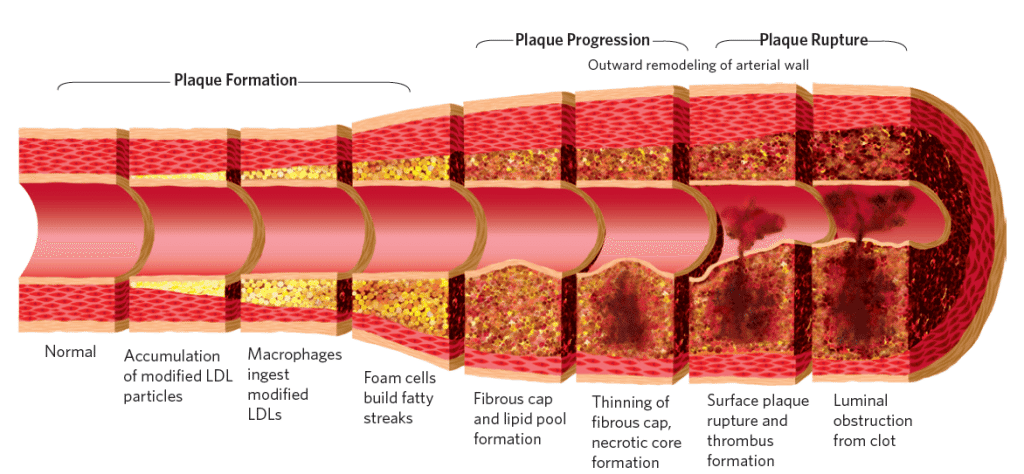
We also include myeloperoxidase (MPO), ApoE genotype analysis, and Quest Diagnostic’s Omega-3 and -6 fatty acids testing as part of our standard baseline lab for Premier Care wellness center patients. Specific Genetic cardiovascular markers can also be done, depending on individual risk factors family and history.
Cardiovascular Imaging
Our screening includes a limited echocardiogram, an ultrasound of the heart that uses no radiation. Cardiovascular disease is the leading cause of death worldwide, according to the World Health Organization.
An echocardiogram shows how well your heart muscle and valves are working, so changes can be followed over time.
Each heart test shows something different, and your provider recommends the ones that fit your history.
At our wellness center, we also provide screening of both carotid arteries and a screen for abdominal aortic aneurysms. Our screening also includes a coronary artery calcium score, a CT scan that measures calcified plaque in the arteries of the heart; unlike the ultrasound tests, it uses radiation. If necessary, peripheral vascular screening looking at ankle-brachial indexes can also be done.
We work with Premier Imaging, an ACR-accredited facility, where a radiologist reads and reports on your images. We offer established patients these tests as a bundled screening package at a discounted cash-pay price.
What Contributes to Heart Disease?
There are a number of different factors that can contribute to a person being diagnosed with heart disease. The following are some of the most common:
- Age – The older you get, the more damaged and narrow your arteries can become, weakening your heart muscle.
- Sex – Men are known to be at a higher risk of developing heart disease. On the other hand, women’s risk does increase after menopause.
- Family history – If your relatives have suffered from heart disease, you could be at a great risk of developing it yourself.
- Hormone imbalance – Hormones affect many systems in the body, including the heart and blood vessels. Cholesterol levels, for example, often change after menopause. That’s why we look at your cardiovascular markers alongside your hormone levels.
- Smoking – Nicotine constricts your blood vessels and carbon monoxide will damage the inner lining of your vessels as well.
How Can Rock Creek Wellness Help?
If you want to know whether or not you are at risk of developing heart disease, Rock Creek Wellness can help you. We offer advanced cardiovascular blood testing and imaging to give our patients a clearer picture of their heart health. Contact us today to make an appointment with a member of our talented and caring wellness center staff.